
About Us
How to care for silk scarves
The Little Tibet London : How ? What ? Where ?
The Little Tibet in London is a platform for indigenous Himalayan craftsman to showcase their work of passion for long term sustainable livelihood. The giant Himalaya stretches majestically about 2500kms from East to West and every pouch reveals a legendary skillful craftsman. As if the mighty Jo Mo Lang Ma (mother goddess or Mt Everest) quench their heart and soul with peace and tranquility, so they don’t have to chase time rather be stealth and live locally. For the simple livelihood to the preservation of one's own trait, their skills are not ideally in museums but shared and passed into the community and locals.
This is one of The Little Tibet’s objectives to encourage and improve their local sustainability by working with them and making friends for a mutual beneficiaries and adventures. Places such as Tibet, Nepal, India, Bhutan, Kashmir, Mongolia, Ladakh have been our universe and our admiration.
With their heartfelt sentiments and gazing smile, we able to achieve the highest quality of products that they can produced. In return, our respect and fairness will always a paramount obligation. Each hand made and handcrafted products are especially propagated with stories and real human touch. Most of the materials are locally produced i.e. wools, silk, cotton on hand loomed in cottage industries.
For example, the Tibetan Shoes or Sonpa are made in the southern region of Tibet called Lhokha. In Tibetan “Lho” means south. This is near Chong Gyal Valley where first Tibetan civilisation had begun. After all these social and political turbulence there still is the first Tibetan castle standing in the valley. Lhokha people are very skilful in terms of wool productions and woolen fabrics. In history, all the Dalai Lamas’ and official robes were made in Lhokha.
Then there is Kashmir, people of Kashmir are also called Kashmiri. They are one of the most artistic people in Asia. They work on various materials including silk and wool. Embroidery is one of their key talents. Usually, group of people assemble into a cottage and work and sing together while doing the needle work. Both man and woman do the similar task. The wool come from Tibet and Mongolia are amalgamated with softer Kashmiri wool and hand loomed. Most silk in Kashmir come from other parts of India. Then there is Kantha stitching, popular in the Calcutta and West Bengal. The worn out Saris are cleaned and patched together with running stitches. The different sari fabric merged together gives this unique yet very intriguing pattern. This is mainly done in the rural area of West Bengal when the cultivation season is over and when there is lot of free times in their hand.
More towards the west, there is Ladakh and Ladakyi. Geographically, religiously it is closely linked to Tibet and many Buddhist relics are still preserved in the high Ladakh monasteries such as Lama Yurlu and Likir around 120kms from Chok Lam Sar. Some of the Tibetan beadings for the necklace are carried out by some Tibetan living in Ladakh.
In brief, we are so privileged to work with some of the best local crafts centres to source our collections to share with our valued customers around the world. In addition, we love to hear from our customers about their ideas and desires in the Himalayan textile. Therefore, we are waiting for your advice, appreciation and grief for our journey.
With Warm Wishes
Tenzin
The Little Tibet London Team
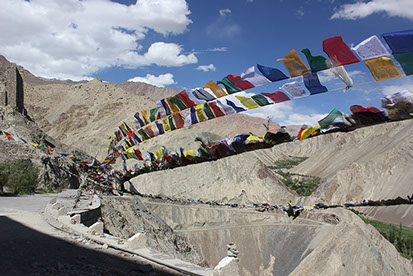
Lungta or Tibetan Prayer Flags High Above Himalayas
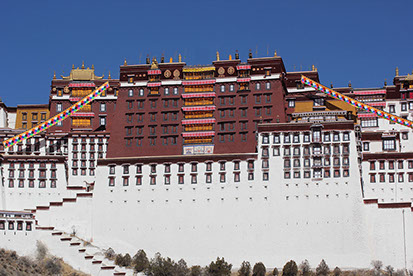
The Great Potala Palace, Built by King Songtsen Gumpo in mid 7th Century BC
How to Care for Silk Scarves
These few basic steps might ensure the preservation of your silk scarves.
Keep well from Jeweleries, accessories and rings from catching your delicate silk scarf while wearing and looking after. Sometimes, your lovely silk scarf might catch zips, sequence dresses, etc.
Store your silk scarf away from direct sunlight. Roll the scarf to prevent creasing rather than folding it or simply stuffing it into a drawer. If you are storing your silk scarf for long periods of time, take it out every six months to allow air to circulate around the silk. As a natural fibre, silk needs to breathe.
Protect your scarf from harsh chemicals and heat. Too much direct sunlight will fade the colours. Harsh chemicals, such as perfume sprayed on your scarf, may cause spotting or even cause the silk fibres to deteriorate. High temperatures will often cause the fibres to shrink. Do not ever put a silk scarf in the dryer.
Dry-clean your scarf if it is a crinkled or brocaded silk. If there is any form of embroidery or embellishment on your scarf, take it to a dry cleaner instead of relying on products at home to clean the silk yourself.
Keep your silk scarf dry. Prolonged exposure to dampness or water will start to stretch and damage the silk fibres. Hand-washing in warm water with a gentle detergent will not damage the fabric as long as there are no embellishments and the scarf is not twisted or agitated in the process. To dry silk scarves, gently press them between two layers of a dry towel. Do not twist or wring it out.
Iron a wrinkled or creased scarf while damp. Use a low heat setting so that the steam will gently press out all creases. Hang silk scarves indoors to dry to prevent damage from the sun and wind.
As stated, aboves are few instructions for looking after your silk scarves but should not be consider as the primary source of knowledge for maintaining the silk quality. Because, not all silks are alike as texture, strength, colour application on them varies.
323x177.jpg)
.jpg)


